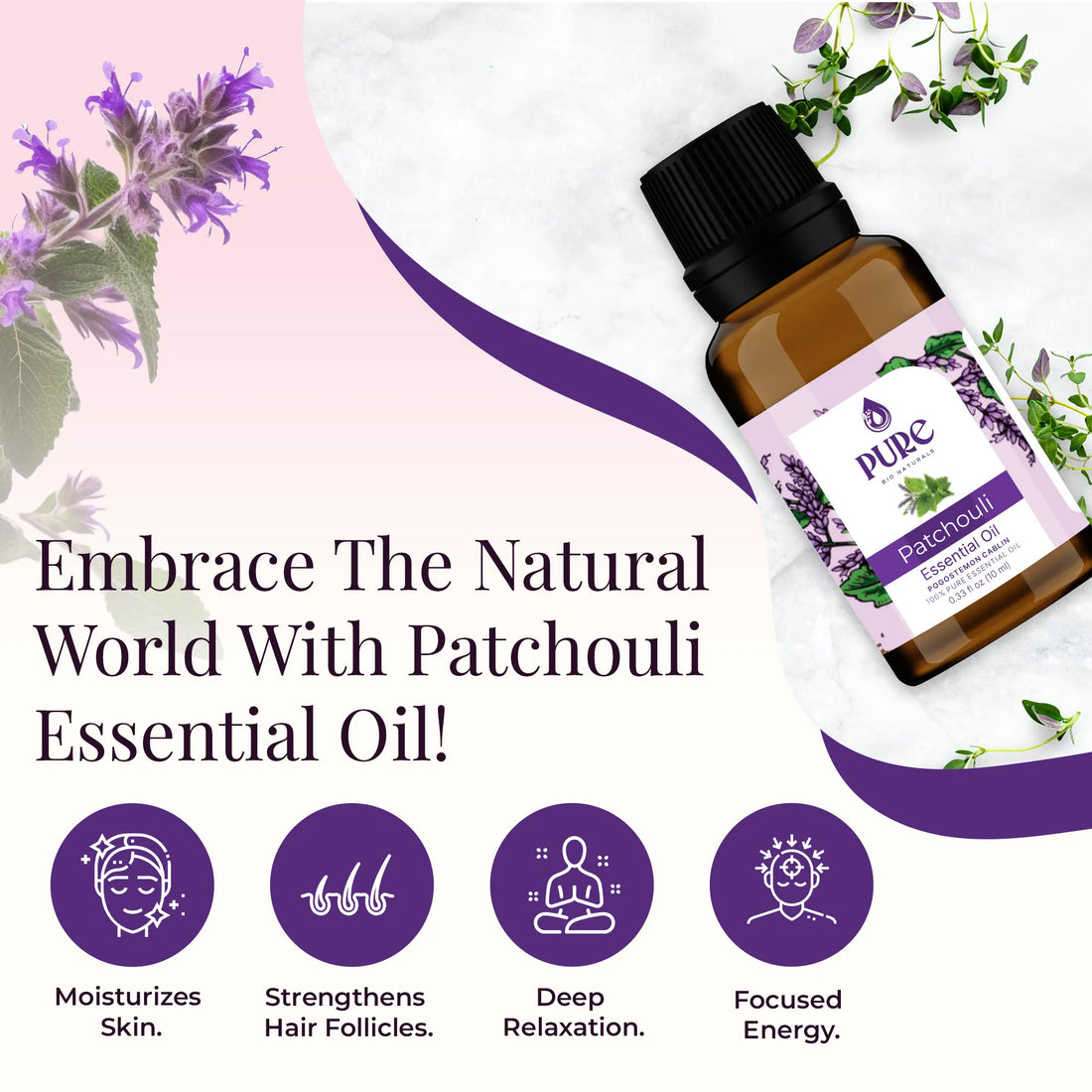
Patchouli Essential Oil: Benefits, Uses and Why It Improves With Age
Share
Patchouli divides people more than any other oil we sell. Some buy a bottle, decide it smells like a share house, and never go back. Others buy it once and keep it for a decade, which turns out to be the right instinct because patchouli is one of very few essential oils that genuinely improves with age.
It is also made differently from almost everything else on the shelf. The leaves are not distilled fresh. They are dried and lightly fermented first, and that step is what creates the scent people recognise.
Patchouli at a glance
|
Detail |
Patchouli |
|---|---|
|
Botanical name |
Pogostemon cablin |
|
Plant family |
Lamiaceae, the mint family |
|
Part used |
Dried and fermented leaves |
|
Extraction |
Steam distillation |
|
Origin |
Indonesia |
|
Colour |
Dark amber to brown |
|
Consistency |
Thick, noticeably more viscous than most oils |
|
Perfumery note |
Base |
|
Aroma |
Deep, earthy and sweet, with a slightly boozy warmth |
|
Blends with |
Sweet orange, bergamot, lavender, rose, jasmine, ylang ylang, sandalwood, vetiver, cedarwood, clary sage |
|
Shelf life |
No practical limit. It improves rather than fades |
Fermentation is what makes patchouli smell like patchouli
Crush a fresh patchouli leaf, and you get something green and fairly ordinary, closer to a mint relative than to the scent in the bottle. The character develops afterwards.
Growers dry the leaves, then stack and lightly ferment them before they go into the still. That controlled breakdown is where the depth, the earthiness and the faint sweetness come from. Nothing else in our range is made this way, and it explains why patchouli does not smell like any other leaf oil.
Why it gets better with age
Most essential oils peak in the first year or two and decline from there. Citrus oils in particular oxidise fast and turn sharp. Patchouli does the opposite.
Over several years, the rough, slightly harsh top notes settle, and the sweetness comes forward. Perfumers pay a premium for aged patchouli for exactly that reason, and in the fragrance trade a bottle held for a decade is treated as a better ingredient than a fresh one, not a worse one.
|
Age |
What usually changes |
|---|---|
|
Fresh, under 1 year |
Sharper, greener, the earthiness sits forward |
|
1 to 3 years |
Edges soften, sweetness becomes more obvious |
|
3 years and beyond |
Rounder and smoother, the character perfumers prefer |
The practical upshot: do not throw out an old bottle of patchouli. Store it capped, cool and dark, and it will keep getting better. The same is true of vetiver and sandalwood, which is worth knowing if you are building a collection of base notes.
What a fixative does, and why it matters
Patchouli is a base note, which in practice means it is heavy and slow to evaporate. Put it under a citrus or a floral and it slows the whole blend down.
A blend of bergamot and rose on its own might hold for an hour. Add two drops of patchouli underneath and it holds for most of a day. That is the entire reason patchouli has been a backbone ingredient in commercial perfumery for decades, long before and long after its association with the 1960s.
If you have ever mixed a blend that smelled wonderful for ten minutes and then disappeared, a base note is what it was missing.
How to use patchouli
In a diffuser
Two to three drops per 100 ml of water, which is fewer than you would use of a citrus. Patchouli is strong and it lingers. Sweet orange alongside it keeps the blend from feeling heavy, and the pairing is a reliable one for a living room in winter.
In a natural perfume
This is where patchouli earns its place. A simple structure to start from: four drops of bergamot on top, two of rose or jasmine in the middle, two of patchouli underneath, all in 10 ml of jojoba.
In a body or roll-on oil
Six to twelve drops per 30 ml of carrier oil, which is a 1 to 2 per cent dilution. Patchouli suits a roll-on better than most oils because the scent develops on skin over an hour rather than announcing itself immediately.
In soap and candle making
Patchouli holds its scent through heat better than almost anything else, which makes it a staple of earthy, unisex handmade products. Soap makers use it to anchor citrus oils that would otherwise fade during curing.
In drawers and wardrobes
A few drops on a cotton pad tucked among stored clothes. Keep it off the fabric itself, because the oil is dark and will stain.
Blending ratios that work
|
Blend |
Drops |
Where it suits |
|---|---|---|
|
Patchouli + sweet orange |
1 : 3 |
Living room diffuser, winter |
|
Patchouli + bergamot + rose |
2 : 4 : 2 |
Natural perfume, 10 ml jojoba base |
|
Patchouli + lavender |
1 : 4 |
Evening diffuser, softer result |
|
Patchouli + cedarwood + bergamot |
1 : 2 : 3 |
Unisex roll-on |
|
Patchouli + vetiver |
1 : 1 |
Base note pairing for perfumery, use sparingly |
The pattern is consistent: use less patchouli than whatever you pair it with. One drop too many turns a blend muddy, and you cannot take it back out.
Is patchouli gentle on skin?
Patchouli has a low irritation rate compared with oils like clove, cinnamon bark or thyme, and most people tolerate it well at normal dilutions. That is not a reason to skip dilution or the patch test. Gentle by essential oil standards still means concentrated.
Safety
- External use only. Do not swallow it.
- Dilute before skin contact, at 1 to 2 per cent, which is 6 to 12 drops per 30 ml of carrier oil.
- Patch test on your inner forearm and check after 24 hours.
- The oil is dark and will stain light fabric and pale surfaces. Let a body blend absorb before dressing.
- Keep it away from the eyes and inner ears. If oil gets in an eye, wipe it with a carrier oil or full-cream milk rather than water, then seek medical advice.
- Patchouli is heavy and some people find it sedating in quantity. Go lightly in a diffuser until you know how it affects you.
- If you are pregnant or breastfeeding, check with your healthcare professional before using it.
- Do not use it on children under two, and halve the adult dilution for older children after checking with a doctor or pharmacist.
- Ask your vet before diffusing around pets, and leave them a way out of the room.
- Store tightly capped somewhere cool and dark, unreachable of children. If any is swallowed, call the Poisons Information Centre on 13 11 26.
Where patchouli fits in a collection
If you already own citrus and floral oils and your blends keep fading, patchouli is the gap. It is the cheapest serious base note in the aromatherapy range, well below sandalwood, and it does a similar job.
Our patchouli is steam distilled from Indonesian Pogostemon cablin and comes in 10 ml, which at two drops a time is a long-term purchase rather than a consumable.
Frequently asked questions
1. Why are patchouli leaves fermented before distilling?
Fresh patchouli leaves smell green and fairly plain. Drying and lightly fermenting them is what produces the deep, earthy, slightly boozy character everyone recognises. The process makes the oil as much as the plant does.
2. Does patchouli oil really get better with age?
Yes, and it is unusual in that. Most essential oils peak early and decline. Patchouli's rougher top notes soften over several years and the sweetness comes forward, which is why aged patchouli is prized in perfumery and why an old bottle is worth keeping rather than replacing.
3. What does a fixative actually do in a blend?
It slows down how fast the lighter oils above it evaporate. Patchouli is a heavy base note, so a citrus or floral blend that would normally fade within an hour holds on for several. If your blends smell wonderful and then vanish, a base note is what they are missing.
4. What does patchouli smell like?
Deep and earthy, with a sweet, slightly boozy warmth and a woody base. People tend to either take to it immediately or need a few encounters with it. There is not much middle ground.
5. How many drops of patchouli go in a diffuser?
Two to three per 100 ml of water, which is less than you would use of a citrus oil. It is strong and it lingers, so start low. Sweet orange or bergamot alongside it stops the blend feeling heavy.
6. Will patchouli oil stain?
It can. The oil is dark amber, so keep it off light fabrics and pale surfaces, and let a body blend absorb before you get dressed.